The Wales Narrow Gauge Grand Tour
After months of planning, studying timetables, and quietly imagining the journeys ahead, the Wales Narrow Gauge Grand Tour is finally here.
On June 19th, I left Dorridge by train and began a slow railway journey across Wales, travelling along the beautiful Cambrian Coast and visiting some of Britain’s most remarkable narrow gauge railways along the way.
The journey includes:
- the Vale of Rheidol Railway to Devil’s Bridge
- the historic Talyllyn Railway
- a nostalgic return to Fairbourne and the Fairbourne Railway
- the spectacular Ffestiniog Railway and Welsh Highland Railway
- and finally the ascent into the mountains aboard the Snowdon Mountain Railway
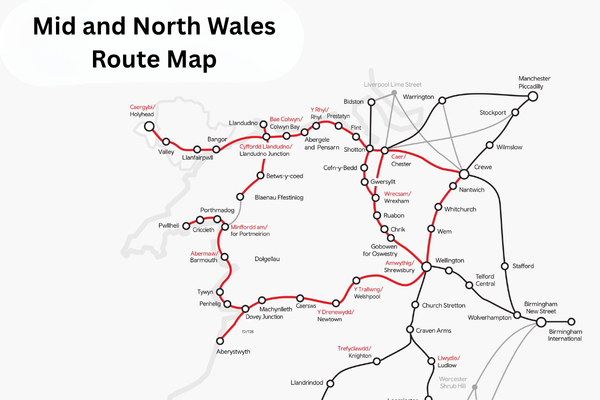
This page will serve as a living travel journal throughout the tour — a place to share photographs, daily notes, railway observations, changing landscapes, and the quieter moments that happen between destinations. More than simply a checklist of railways, this journey is about travelling slowly, reconnecting with places, and experiencing Wales through the rhythm of its railways.
As the journey unfolds, I hope this page will become both a record of the tour itself and a reflection of everything that Along Narrow Lines is really about: scenic rail travel, narrow gauge railways, nostalgia, landscape, and the simple pleasure of the journey.
1. Out of the Midlands, Into Wales
There's a version of this journey that started decades before I ever booked a ticket.
As a child, summer meant Fairbourne. My family would take us to stay with friends there, and the first thing that happened on arrival, almost before the cases were unpacked, was that we children were handed a season ticket for the Fairbourne Railway. Two miles of narrow gauge track out to Penrhyn Point and back, over and over, for as long as the holiday lasted. I couldn't tell you now how many times I made that short journey across a single summer, only that it felt, at the time, like it might be limitless — that the little train and the sand and the estuary light would simply go on forever, the way childhood summers always convince you they will. When the whole family wanted a bigger day out, it was usually the Talyllyn Railway or the Ffestiniog that got us, chuffing off into hills that felt enormous to a child, though I now know them to be gentle by any real mountain standard.
Those two miles of track, and those family days further into the hills, have stayed with me in a way I didn't fully appreciate until much later in life. It became one of those quiet, unfinished thoughts that sits at the back of your mind for years — one day I'll go back. Retirement, as it turns out, is precisely the kind of gap in a life where a thought like that finally gets the room it needs to become a plan. So this journey isn't really about narrow gauge railways in the abstract, however much I love them. It's about going back to Fairbourne as the adult I've become, and seeing whether the places that shaped so many childhood summers still hold whatever it was they gave me then — and about visiting, properly this time, the wider narrow gauge world of Wales that those childhood day trips only ever gave me a glimpse of.
But every journey, however long it's been forming, still has to start with a door closing behind you, and mine closed a mile from Dorridge station, on a morning that felt ordinary right up until it wasn't.
Dorridge itself is a modest sort of station — the kind you could easily overlook if you weren't setting off on something you'd been thinking about for months. I've passed through it more times than I could count, but rarely with a bag packed for two weeks and a folder of railway timetables tucked under my arm. The Chiltern Line train into Birmingham Moor Street is a journey I know in my bones. I did it every day once, years ago, as a college student with nowhere near this much on my mind. There's something quietly strange about retracing a commute you haven't made in decades and finding it's the opening move of an entirely different kind of trip.
Moor Street is a small, handsome station, and it hands you off to New Street with a five-hundred-metre walk that gives you just enough time to shift mentally from commuter to traveller. And New Street was busy. Properly busy — busier than I'd expected for a Transport for Wales service heading deep into the Cambrian Mountains on a Friday. I got talking to a couple on the platform, heading to Barmouth for a family gathering, and it struck me how many quiet reasons there must be for all these people to be going the same broad direction as me, each carrying their own version of this journey.
Then came the announcement, and with it, the first small comedy of the trip.
The train was a Transport For Wales Class 158 Sprinter Express comprising four carriages. We were told: front two for Barmouth and Pwllheli, rear two for Aberystwyth. I said goodbye to my new acquaintances, made my way to the back of the train, and found a forward-facing window seat — a detail that will matter shortly. Across from me sat a lady on her own; across the aisle, a young couple already settled in. Nobody spoke, in that particular way that only happens on trains, where forty strangers agree without discussing it to share a carriage in complete silence.
Class 158 Sprinter at Shrewsbury Station
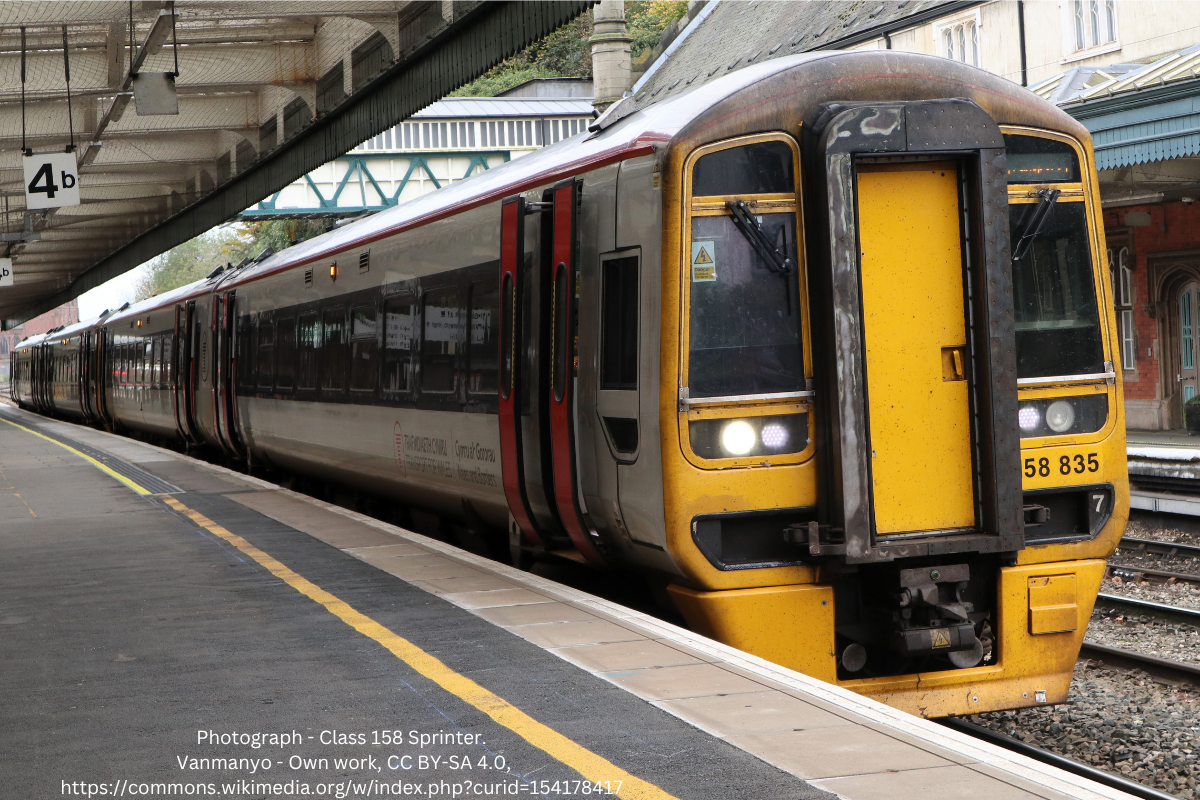
This is a route with a long memory of exactly this kind of division. Long before Transport for Wales, long before Arriva or Wales & Borders or even British Rail, the old Cambrian Railways were built in the 1850s and 60s to do precisely this — carry Midlands and English trade out to the coast, then split at the last practical moment to serve two different Welsh destinations from one train. In the grand GWR era, the Cambrian Coast Express used to divide its portions at Shrewsbury itself, one half peeling off behind a Manor Class locomotive for Aberystwyth, the other for Pwllheli, with two engines doing the work one had done as far as Wolverhampton. It's a century-old habit, this splitting of trains in the Welsh borders, and it turns out the habit hasn't lost its capacity for confusion.
At Telford, a middle-aged man got on and asked, quite reasonably, whether this was the carriage for Pwllheli. The young couple beside me said yes. I said no — Aberystwyth. A small, polite disagreement broke out, the kind where everyone is certain and everyone is being terribly English about it. The lady opposite suggested we not worry; the conductor, she said, would sort us out before Machynlleth. Nobody was rude. Nobody was quite right either, as it turned out — including me.
We called at Wolverhampton, Telford, Shrewsbury, and it was at Shrewsbury that the truth of the matter revealed itself, though not through argument but through physics. The train reversed out of the station the way it had come in, and my forward-facing seat quietly became a backward-facing one. The front of the train was now the back. Everything the announcements had said was still true — it was just that the train itself had turned itself inside out, and none of us had noticed. That was the whole mystery, solved by nothing more than which way the carriages happened to be pointing.
It broke the ice properly. A railway worker joined at Shrewsbury and somehow the five of us fell into an easy conversation about trains, golf courses in Wales, and the weather — the three great British icebreakers, deployed in sequence like an unspoken ritual. When the conductor finally came through and gently redirected the Pwllheli-bound passengers to the rear, the young couple laughed and admitted I'd been right from the start. There's a particular satisfaction in being vindicated by a train's own geometry rather than by an argument, and I'll admit I enjoyed it more than I probably should have.
By then the landscape outside had already begun its slow transformation — the flat industrial edges of Wolverhampton and Telford giving way, somewhere past Shrewsbury, to the first folded hills of Wales. Fields replaced factories. The light changed the way it does when a place starts meaning something different.
Machynlleth Station
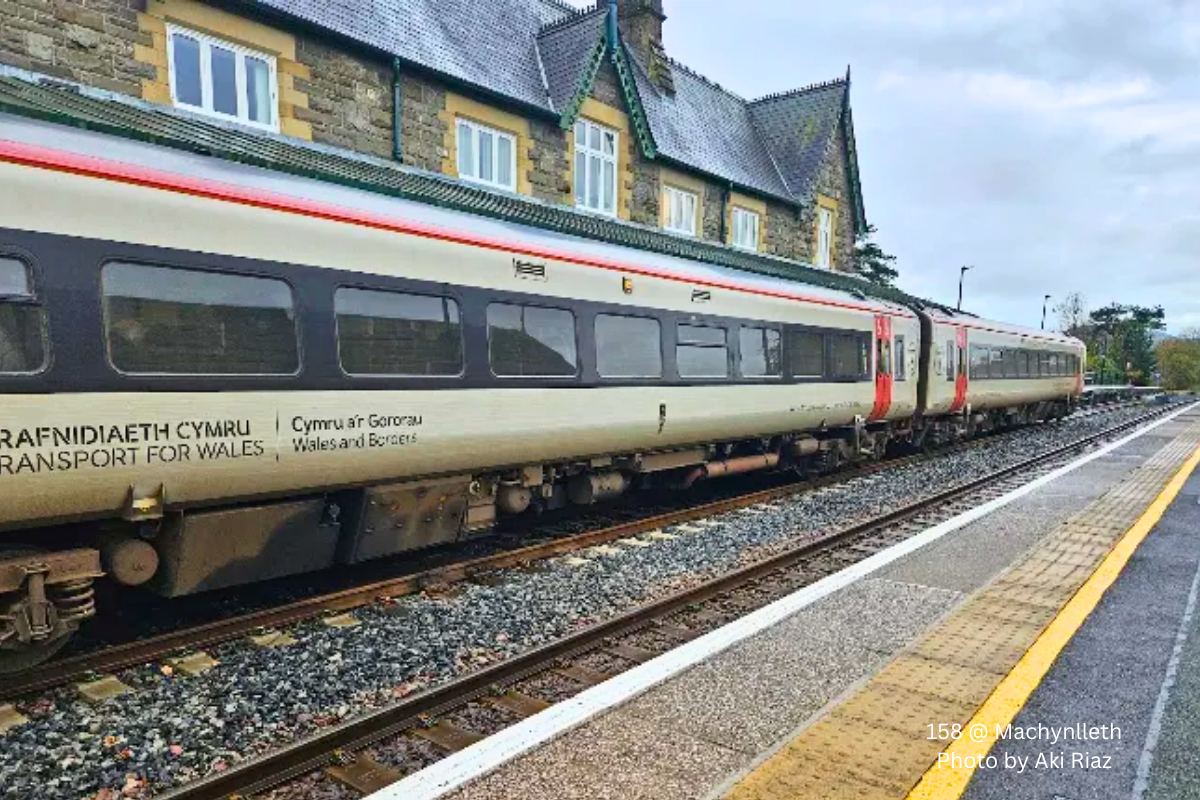
At Machynlleth you don't just hear the train divide, you feel it — a shudder through the carriage as the two portions are uncoupled, a small mechanical decision that will send half the train north to Pwllheli and half of it, mine, on toward the coast. From there the line runs down through Dyfi Junction (Dovey Junction) and alongside the River Dyfi itself, one of the most quietly beautiful stretches of railway in Britain, before reaching Borth and finally Aberystwyth. It's a landscape built by water — river, estuary, sea, arriving in that order, each one widening the view a little further, until the sea simply takes over and there's nowhere left to go but the terminus.
I stepped off the train into Aberystwyth with the peculiar feeling that the journey had already properly begun, somewhere back around Shrewsbury, in a carriage full of strangers arguing gently about a mistake that wasn't really anyone's fault.