Steam At Statfold Barn Railway.
A Summer Spectacle of Steam
Steam At Statfold Barn Railway. Discover how a day at Statfold Country Park's Summer Spectacle of Steam became the perfect overture to my Wales Narrow Gauge Grand Tour, celebrating heritage railways, photography, nostalgia, and the quieter pleasures of steam travel.
As my Wales Narrow Gauge Grand Tour edged ever closer, I found myself in need of a little overture before the main performance.
In less than two weeks, I would be setting off from Dorridge Station on a slow railway journey across Wales. The plan is simple enough on paper: travel by train to Aberystwyth, follow the Cambrian Coast northwards, and visit some of Britain's most remarkable narrow gauge railways along the way. Yet, like many anticipated journeys, the adventure had already begun long before I began packing a bag or checking the timetable for the hundredth time.
Perhaps that is why a visit to the Summer Spectacle of Steam at Statfold Barn Railway felt so appropriate.
It wasn't part of the Grand Tour itself.
And yet, somehow, it was.
Arrival at Statfold
Situated just a couple of miles from Junction 11 of the M42, Statfold Country Park is remarkably easy to find. Within minutes of leaving the motorway, I was turning into the extensive car park and making my way towards the modern entrance building.
Everything about the place felt organised and welcoming.
Yet before I had even reached the ticket desk, the atmosphere of the day had already begun to work its magic.
The familiar smell of coal smoke drifted through the warm summer air.
Steam whistles echoed somewhere beyond the buildings.
Unseen locomotives were already hard at work.
I had arrived.
One of the first things I noticed was the sheer variety of people attending the event. There were older enthusiasts like myself, younger railway devotees with an obvious depth of knowledge and enthusiasm, families introducing children to the delights of steam for what may have been the very first time, and photographers everywhere.
Many carried impressive cameras fitted with telephoto lenses. Others had sturdy tripods slung over their shoulders or video cameras complete with furry microphones to tame the breeze.
Everyone had come for the same reason.
To enjoy the spectacle of steam at Statfold Barn Railway.
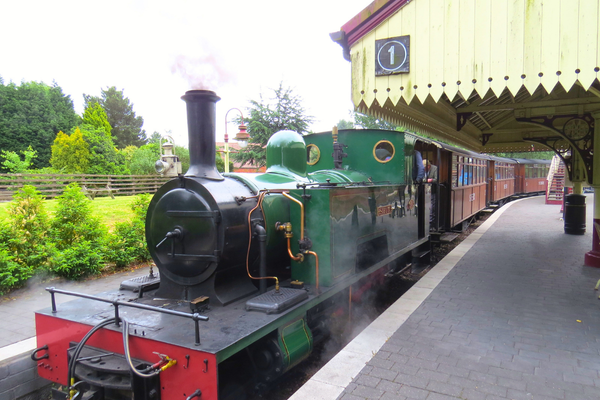
More Than Just a Railway
Before visiting, I had thought of Statfold largely as a heritage railway.
By the end of the day, I realised it is something rather more remarkable.
Statfold Country Park grew from the private collection of businessman and railway enthusiast Graham Lee, whose passion for narrow gauge locomotives developed into one of the finest collections in the country. What began as a desire to preserve and restore these extraordinary machines gradually expanded into a destination that combines working railways, museums, workshops, fairground attractions and family entertainment.
Today, it is home to the Statfold Barn Railway, an extensive two-foot gauge operation featuring an impressive fleet of steam and diesel locomotives, many of which once worked in industries around Britain and overseas.
Unlike some collections where exhibits sit silently behind barriers, Statfold is a living railway.
The locomotives move.
They breathe.
They work for their living once more.
Children wave enthusiastically from carriage windows while seasoned photographers patiently wait for the perfect composition.
Steam drifts across the platforms.
The collection is not simply preserved.
It is alive.
First Impressions
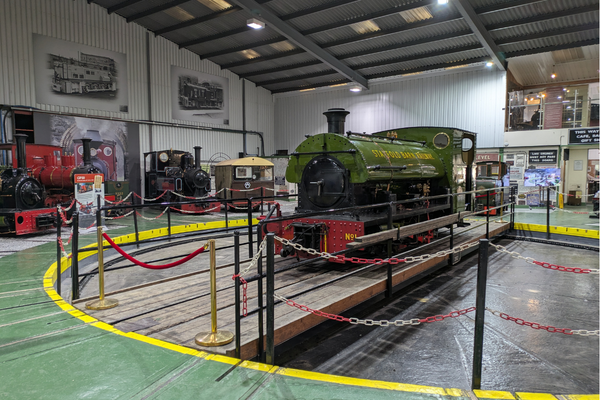
The first exhibit I encountered was the Roundhouse Museum.
Home to a substantial portion of the Statfold Collection, the museum houses an extraordinary range of steam and diesel locomotives from around the world. Information panels and interactive displays tell the stories of the engines and the industries they once served.
I could have spent an hour or two exploring every exhibit, (which I did do later at the end of my visit).
But the sounds from outside proved irresistible.
Steam whistles called from somewhere beyond the museum walls.
Passengers laughed as trains arrived and departed.
There would be time to return later.
The trains were waiting.
Coffee Before Steam
No railway day should begin without refreshments.
After fortifying myself with a welcome coffee and a rather excellent pain au chocolat from the café, I followed the signs leading deeper into the site.
The instructions could not have been simpler.
"To The Trains."
It struck me then how those three words captured the spirit of the day perfectly.
No complicated itinerary.
No urgency.
Simply a gentle invitation.
Follow the signs.
See where the rails lead.
And enjoy the journey.
The Mease Valley Light Railway
My first railway ride of the day was aboard the Mease Valley Light Railway.
Added to Statfold Country Park in recent years, this charming little line runs on a gauge of just 12¼ inches. In the grand scheme of railway history, it is tiny. Yet, as I was to discover, size has very little to do with enjoyment.
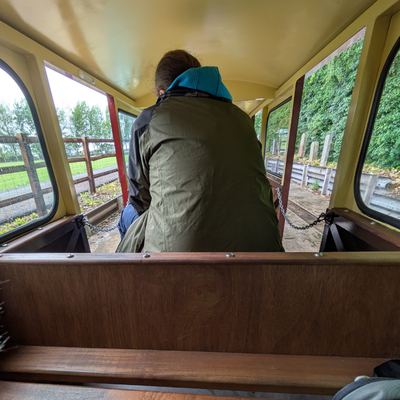
The carriages themselves were delightfully compact. Those of us blessed with slightly less flexibility than we once possessed soon discovered there wasn't a great deal of headroom, but that somehow added to the experience. It reminded me that narrow gauge railways have always operated on a more intimate scale. They invite you to lean in a little closer.
As the train pulled away from Oak Tree Halt, we settled into a gentle circuit around the park.
The pace was unhurried.
The scenery unfolded quietly.
At Mallard Halt, the line passed alongside a small lake where two elegant swans drifted serenely across the water. Nearby, a solitary heron stood perfectly still at the water's edge, seemingly unimpressed by the excitement and noise surrounding it.
Steam and wildlife shared the same landscape without difficulty.
There was something rather lovely about that.
The train passed the camping area before offering glimpses of the National Fairground Museum, another of the many attractions tucked away within the Country Park. Then, approaching the entrance road, we encountered one of the unexpected moments that stayed with me long after the day had ended.
Two young volunteer Police Cadets stood guard at the level crossing.
As each train approached, they stopped the traffic with admirable seriousness before enthusiastically waving to the passing passengers.
The passengers waved back.
Every single time.
It was such a small thing, and yet it captured something important about heritage railways. These places survive not only because locomotives are restored and maintained, but because people give their time, enthusiasm and kindness to create experiences that others will remember.
Sometimes, preserving history is simply a matter of teaching the next generation to wave at passing trains.
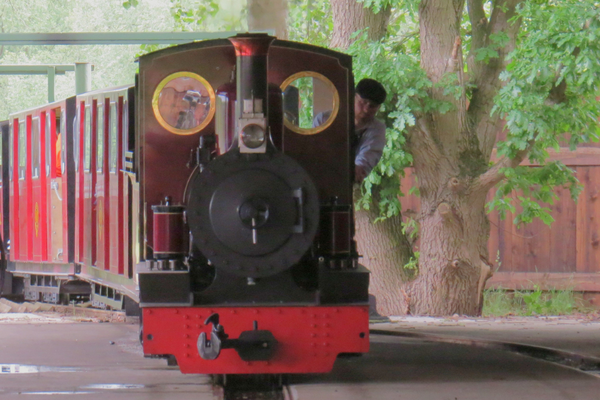
Steam Everywhere
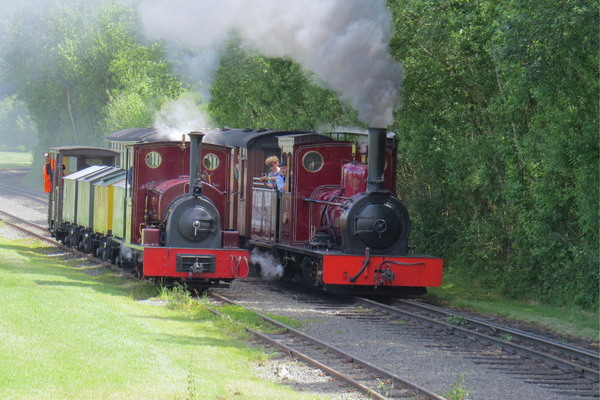
Returning to Oak Tree Halt, I found the larger two-foot gauge railway in full flow.
Steam locomotives appeared from seemingly every direction.
Most hauled coaches full of smiling passengers, although occasional goods trains added authenticity and variety to the spectacle. Their presence hinted at the industrial origins of many of these locomotives, reminding visitors that before they became objects of affection and preservation, they had once worked for a living.
I found myself doing something I suspect many visitors do at events like this.
Nothing at all.
I simply stood on the platform and watched.
Trains arrived.
Passengers disembarked.
Whistles sounded.
Steam drifted lazily through the sunshine.
Children pointed excitedly.
Conversations ebbed and flowed around me.
Sometimes that's enough.
In a world increasingly obsessed with doing more, seeing more and documenting every moment, there is a quiet pleasure in simply standing still and observing.
Perhaps that is one of the reasons heritage railways appeal to so many of us.
They give us permission to slow down.
Along the Line to Cogan Halt
Eventually, a fellow enthusiast struck up a conversation and suggested I walk further along the line towards Cogan Halt.
"You'll get some good photographs from down there," he said.
Advice from fellow railway enthusiasts is usually worth taking.
Camera bag over one shoulder and tripod in hand, I followed the grassy path beside the railway. The walk itself became part of the experience. Locomotives worked steadily through the landscape while visitors gathered at various vantage points, each hoping to capture the perfect image.
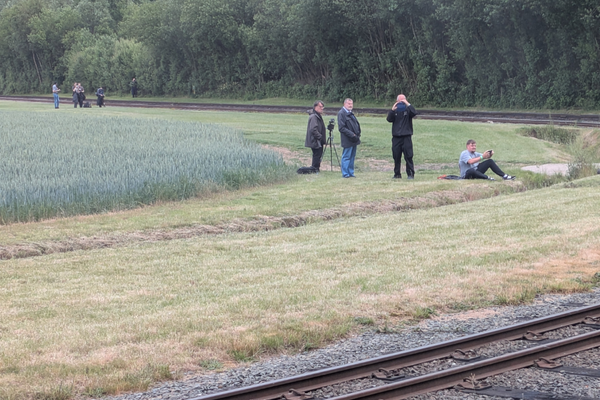
Railway photography has its own rhythm.
It isn't simply about recording a locomotive.
It is about preserving an atmosphere.
Steam drifting into the trees.
Sunlight catching polished brass.
Reflections in carriage windows.
Passengers leaning out to wave.
The anticipation as distant exhaust beats announce an approaching train long before it comes into view.
At Cogan Halt, I set up my tripod and waited.
Train after train passed before me.
I adjusted settings.
Changed angles.
Pressed the shutter.
And occasionally forgot to take photographs altogether because I had become absorbed in simply watching.
I like to think I came home with one or two decent pictures.
But even if every image had been hopelessly out of focus, the experience itself would have been worthwhile.
Lunchtime Conversations
Eventually, the morning slipped away and lunchtime beckoned.
Returning to the café, I ordered a cup of tea and a toasted ham and cheese panini that proved every bit as enjoyable as railway café food ought to be.
Standing in the queue, I found myself chatting to a lady from the Narrow Gauge Railway Society.
As often happens among railway enthusiasts, the conversation moved quickly from the weather to future travel plans.
When I mentioned my forthcoming Wales Narrow Gauge Grand Tour, her interest was immediate and genuine.
We spoke about the Talyllyn Railway, the Ffestiniog Railway and the Welsh Highland Railway. There were recommendations, observations and shared enthusiasm.
Before long, she encouraged me to visit the Society's stand later in the day.
I promised that I would.
Moments like these remind me that railway enthusiasm has always been about community as much as machinery.
Complete strangers discover common ground within minutes.
Friendships begin beside station platforms.
Conversations that start over tea and paninis somehow find their way to memories of childhood holidays, favourite locomotives and journeys still waiting to be taken.
As I carried my tray back to the table, I realised that Statfold was offering something more valuable than simply a collection of steam locomotives.
It was providing connection.
A gathering place for people who understood why a drifting plume of steam or the distant sound of a whistle can still stir something deep within us.
And all the while, somewhere outside beyond the café walls, the trains continued to run.
The afternoon adventures were still waiting.
Steam At Statfold Barn Railway
After lunch, it was finally time to experience the railway that sits at the heart of Statfold Country Park.
The Statfold Barn Railway is, in many ways, the reason the entire site exists. What began as a private collection of narrow gauge locomotives gradually evolved into a fully functioning railway capable of demonstrating these remarkable machines in the way they were intended to be seen — working, moving and carrying passengers.
Today, the railway forms the centrepiece of the visitor experience.
And on a gala day such as the Summer Spectacle of Steam, it truly comes alive.
Back at Oak Tree Halt, another train soon arrived and I climbed aboard for the journey towards Statfold Junction.
The coaches filled quickly with families, enthusiasts, photographers and day-trippers, all eager to enjoy the ride.
With a whistle from the locomotive, we were off.
The Theatre of the Turntable
When we arrived at Statfold Junction, many passengers immediately crossed to the opposite platform to board the returning train.
I stayed where I was.
The locomotive crew had work to do.
One of the great pleasures of heritage railways is watching the practical side of railway operation. Modern transport often hides its workings from view, but heritage railways place them centre stage.
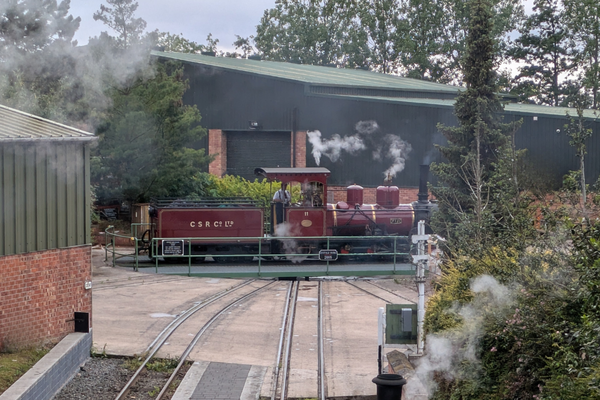
The locomotive was uncoupled from its train and carefully moved towards the turntable.
Slowly, almost ceremonially, the engine was rotated to face the opposite direction.
Steam drifted lazily from safety valves.
Crew members exchanged signals.
Couplings clanked.
The locomotive backed carefully onto the waiting coaches.
Within a few minutes, everything was ready for the return journey.
To some visitors, it may have looked like a routine operation.
To me, it felt like theatre.
Not dramatic theatre.
Not loud theatre.
But the kind of quiet, skilled performance that rewards careful observation.
Watching volunteers perform these tasks with confidence and precision reminded me once again how much knowledge and dedication exists within the heritage railway world.
Many of these people give up weekends and evenings simply because they love these railways and want others to experience them.
Without that commitment, places like Statfold simply would not exist.
Two Trains, Side by Side
The return journey provided another memorable moment.
After leaving Statfold Junction, our train continued south towards Cogan Halt.
As we rounded the loop at the far end of the line, another train appeared on the adjacent track.
For a few wonderful minutes, the two trains travelled side by side through the countryside.
Cameras emerged from windows.
Steam drifted across the gap between the two trains.
It felt almost like a scene from a railway film.
Simple.
Unexpected.
And strangely joyful.
Those are often the moments that stay with us longest.
Not the planned highlights.
Not the headline attractions.
Just a brief moment when everything seems to come together perfectly.
Joining the Narrow Gauge Railway Society
Later in the afternoon, I remembered my promise to visit the stand of the Narrow Gauge Railway Society.
The Society has long been one of the most important organisations supporting narrow gauge railways and their preservation. Through publications, events, archives and membership, it helps keep the history and future of these railways alive.
The volunteers on the stand were welcoming and generous with their knowledge.
I found myself talking once again about my forthcoming Wales Narrow Gauge Grand Tour.
The conversation flowed naturally from Talyllyn to Ffestiniog, from Fairbourne to Welsh Highland, and before long I realised I was among people who understood exactly why such a journey appealed to me.
There is a comfort in finding your tribe.
After another enjoyable discussion, I decided to join.
It felt entirely appropriate.
After all, many of the railways that inspired Along Narrow Lines owe their survival, at least in part, to the efforts of enthusiasts and organisations like this.
It felt like an investment in the future of the very railways I enjoy visiting.
Museums and Unexpected Discoveries
As the afternoon slowly drifted towards evening, I finally returned to the museum buildings I had walked through earlier.
Locomotives from around the world stood proudly on display, each carrying its own story and history.
Some had worked in quarries.
Others in industry.
Some had travelled halfway around the world before finding a new home at Statfold.
Walking among them, it became clear just how remarkable the collection really is.
This was not simply a gathering of locomotives.
It was a collection of stories.
Each engine represented a chapter in the wider history of narrow gauge railways.
One exhibit in particular brought a smile to my face.
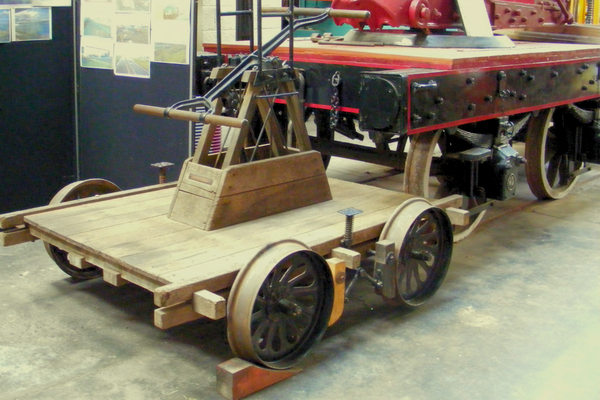
Among the displays was a traditional pump-action railway handcar — the sort of vehicle many of us recognise instantly from old Western films.
Seeing one in person was oddly satisfying.
For years I had assumed they belonged mainly to the world of Hollywood.
Yet here was a genuine example, a reminder that railway history often turns out to be even more interesting than the stories we grow up watching.
Steam Beyond the Rails
As I made my way back towards the car park, one final surprise awaited.
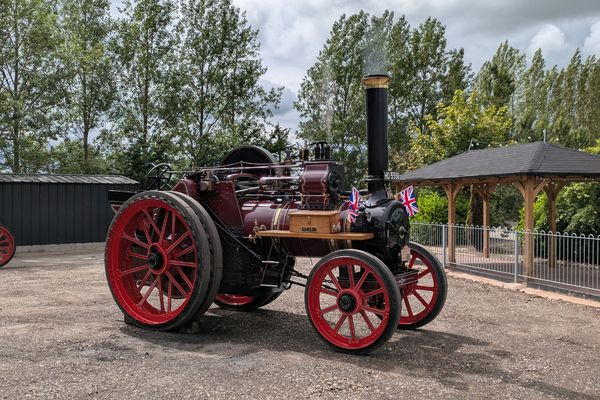
Three magnificent steam traction engines stood on display.
One was in steam.
Another was being lovingly polished by its owners.
The care and pride invested in these machines was obvious.
Visitors gathered to admire them, ask questions and take photographs.
Watching the owners tending their engines, I was struck by the similarities between traction engine preservation and railway preservation.
In both cases, people devote enormous amounts of time, money and effort to preserving a piece of history.
Not because they have to.
But because they care.
And perhaps that is what places like Statfold celebrate best.
Not simply steam power.
But the people who keep its story alive.
Slow down. Watch the train arrive. Travel along narrow lines.